Vintage vs Antique Engagement Rings: What's the Difference
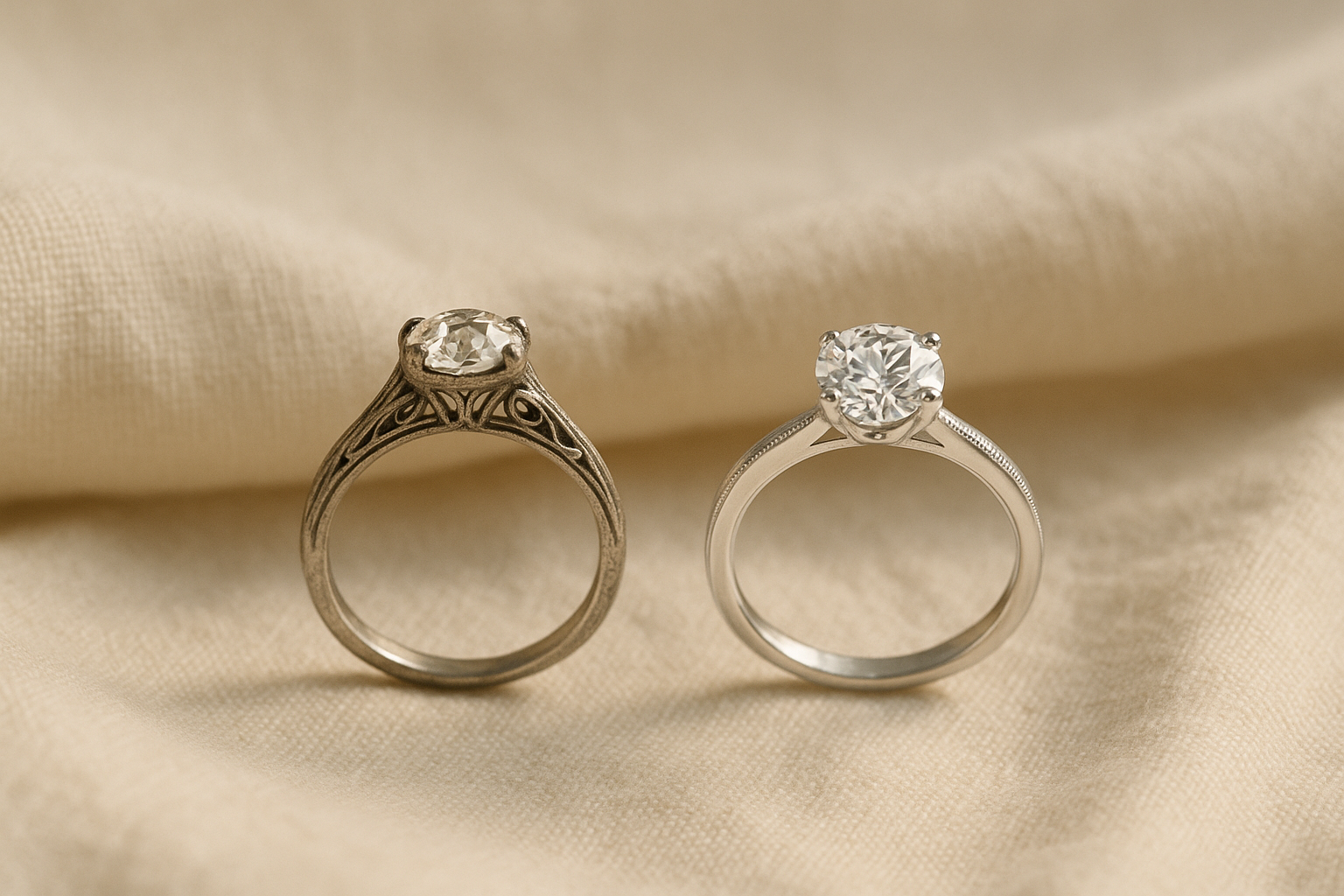
An antique engagement ring is 100 or more years old; a vintage ring is commonly 20 to 50 years old, though the term has no fixed legal definition. Retro names a specific mid-century design period, and vintage-inspired means a newly made ring that reproduces era details like milgrain, filigree, and old-style diamond cuts.
TL;DR
- An antique engagement ring is 100 or more years old; vintage commonly means 20 to 50 years old, though no legal definition exists. Ask the seller for the ring’s estimated production date in writing before you buy.
- Retro refers specifically to mid-century design (roughly 1940s-1950s), not just “old”. If a listing says retro, expect bold gold, larger scrollwork, and colored stones rather than delicate filigree.
- Vintage-inspired means newly made with era details like milgrain, filigree, and old-style cuts. It gives you the antique look with modern prongs, fresh metal, and a certified stone, which is the safer choice for daily wear.
- True antiques often carry uncertified stones, thin worn shanks, and resizing limits. Before buying one, get an independent appraisal and confirm the ring can be sized to your finger without damaging engraving or filigree.
- Old mine cut and old European cut diamonds have taller crowns, smaller tables, and chunkier facets than modern round brilliants. They show softer, broader flashes of light; if you want maximum sparkle, choose a modern cut in a vintage-inspired setting.
- If certification matters to you, commission a vintage-inspired custom ring with an IGI or GIA graded lab-grown or natural diamond. You control the era details and get documented color, clarity, and cut grades that most antique stones lack.
What Is the Difference Between Vintage and Antique Engagement Rings?
An antique engagement ring is 100 or more years old, while a vintage ring is commonly understood to be roughly 20 to 50 years old - the terms are not interchangeable. The 100-year threshold is a convention used across the jewelry and antiques trade and in US customs import classification [NEEDS PROOF: CBP informed compliance publication on antiques; GIA glossary entry]. “Vintage” has no legally fixed definition; sellers use it loosely, and some apply it to anything that simply looks old [NEEDS PROOF: authoritative glossary acknowledging loose usage]. In practice, a ring made in 1920 is antique. A ring made in 1985 is vintage. A ring made last year with milgrain and filigree is neither - it is vintage-inspired.
Age classification is also separate from design era. Art Deco describes a style, not an age, so a ring can be Art Deco in design without being antique in age - reproductions are common. The distinction matters for three practical reasons:
- Pricing: true antiques carry scarcity and provenance value; vintage-inspired pieces are priced as new manufacture
- Condition risk: a 100-year-old ring has 100 years of wear, prior repairs, and thinning metal
- What a listing promises: “antique-style” or “vintage-inspired” promises a look, not an age
If a listing does not state a production date or era with evidence, treat the age claim as unverified. Buyers comparing genuine period pieces against new engagement rings should confirm which category they are actually being sold before comparing prices.
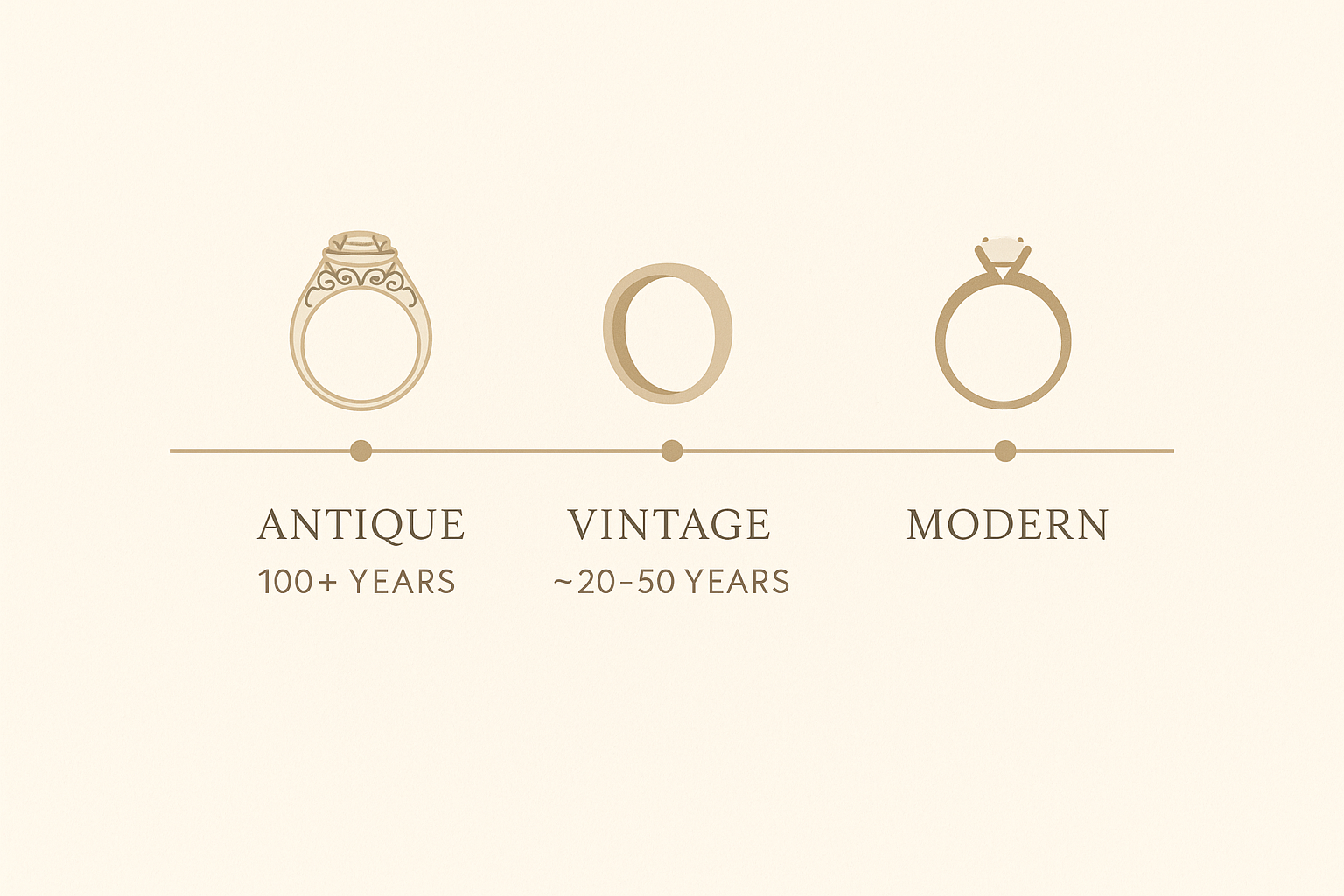
Antique is an age classification of 100+ years; vintage commonly means roughly 20 to 50 years old
How Old Does a Ring Have to Be to Count as Antique?
A ring must be 100 or more years old to be classified as antique, the standard convention used across the jewelry trade and by US customs for import classification [NEEDS PROOF: CBP informed compliance publication on antiques; GIA glossary definition]. The threshold is rolling, not fixed to a calendar era: every year, the line advances, and rings made in the mid 1920s now qualify. That pulls early Art Deco pieces into antique status, a shift that matters for pricing and for evaluating seller claims. “Estate” is a separate term entirely. It means previously owned, at any age. A five-year-old ring resold on consignment is estate jewelry; it is not antique, and sellers who blur the two terms should raise a flag.
Verify age yourself rather than accepting a label. Look for these dating cues, ideally confirmed by a jeweler with a loupe [NEEDS PROOF: published reference on dating jewelry by hallmarks and construction]:
- Hallmarks and maker’s marks inside the shank, indicating metal content, country of origin, and sometimes a date letter
- Construction techniques, such as hand-fabricated galleries, hand-cut filigree, or older solder joins versus cast reproduction work
- Cut style of the center stone: an old mine or old European cut supports an antique date; a modern round brilliant in an “antique” mounting suggests a later replacement or a reproduction
- Documentation: request any appraisal history, prior grading reports, or provenance records the seller holds
No single cue proves age on its own. A consistent picture across marks, construction, and stone cut does.
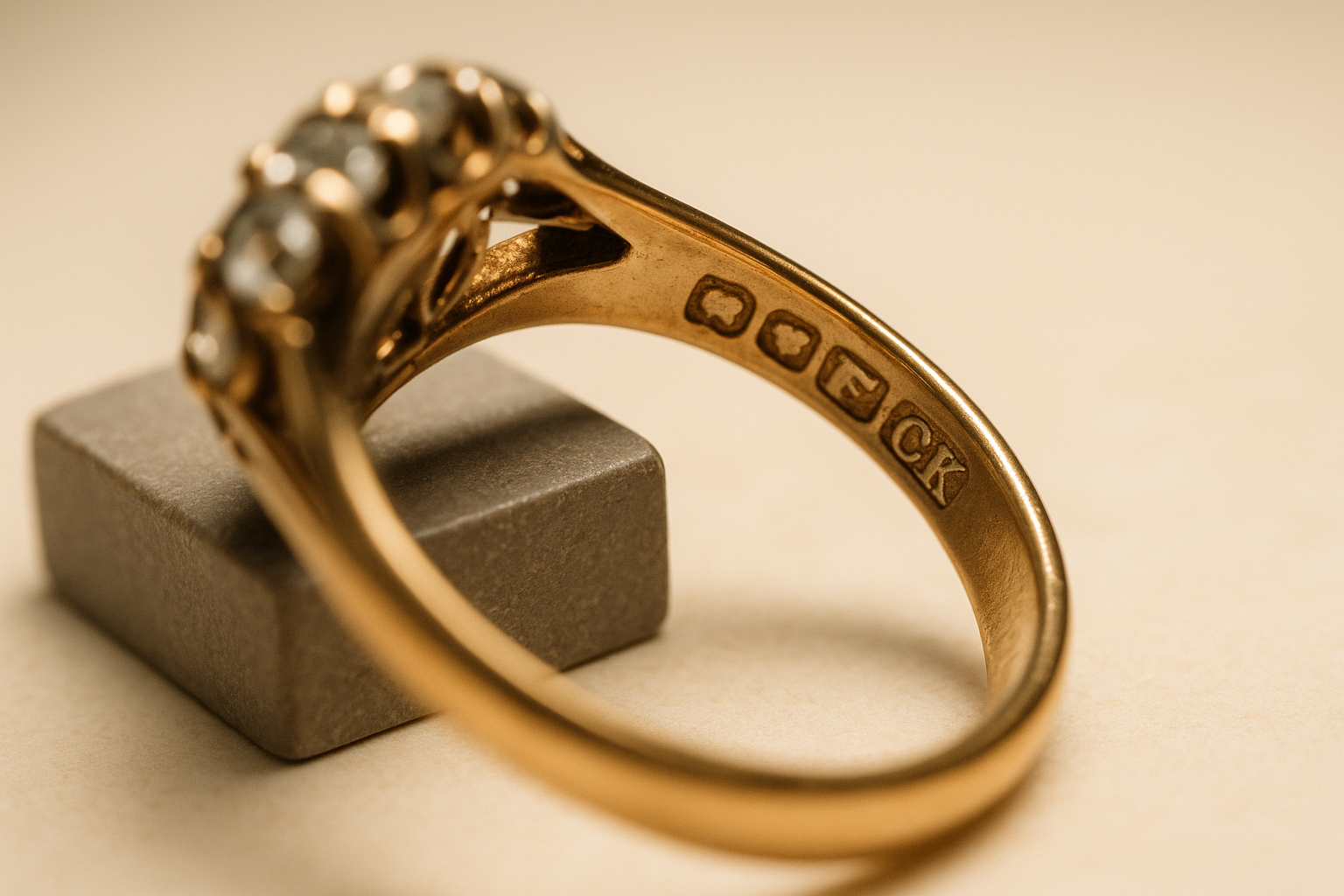
Hallmarks and maker’s marks inside the shank are primary clues for dating an antique ring
What Are the Major Antique Ring Eras: Victorian, Edwardian, Art Deco, and Retro?
The four major antique ring eras are Victorian (circa 1837 to 1901), Edwardian (circa 1901 to 1915), Art Deco (circa 1920 to 1935), and Retro (circa 1935 to 1950), and each has a distinct metal, motif, and cutting-style signature [NEEDS PROOF: cross-check era date ranges against GIA era guides or a published antique jewelry reference]. Victorian rings favor yellow gold, romantic motifs like hearts and snakes, cluster settings, and hand-cut rose and old mine cut diamonds. Edwardian rings shift to platinum lacework: filigree, milgrain edging, and delicate garland motifs made possible by platinum’s strength at thin gauges. Art Deco rings replace curves with geometry - strong symmetry, stepped shoulders, calibre-cut sapphire or onyx accents, and high-contrast color blocking that still influences modern halo designs.
Retro is a specific design period, not a synonym for vintage. Retro rings are bold and sculptural, built with heavy gold volume and large center stones, often colored gems such as aquamarine, citrine, or blue sapphire. The era’s return to gold was driven by wartime restrictions on platinum, which was reserved for military use [NEEDS PROOF: source on US War Production Board platinum restrictions during WWII]. Naming the era you want makes every later decision faster, whether you are hunting estate pieces or commissioning a reproduction.
| Era | Circa dates | Signature metal | Defining details | Typical stone cuts | Buyer takeaway |
|---|---|---|---|---|---|
| Victorian | 1837 to 1901 | Yellow gold | Romantic motifs, clusters, engraving | Rose cut, old mine cut | Warm, sentimental, softest sparkle |
| Edwardian | 1901 to 1915 | Platinum | Filigree, milgrain, garland motifs | Old European cut | Delicate lacework; inspect for wear |
| Art Deco | 1920 to 1935 | Platinum, white gold | Geometry, symmetry, calibre accents | Old European, early transitional cuts | Bold structure; the most reproduced era |
| Retro | 1935 to 1950 | Yellow and rose gold | Sculptural volume, large colored centers | Transitional and early brilliant cuts | Statement scale at lower per-carat cost |
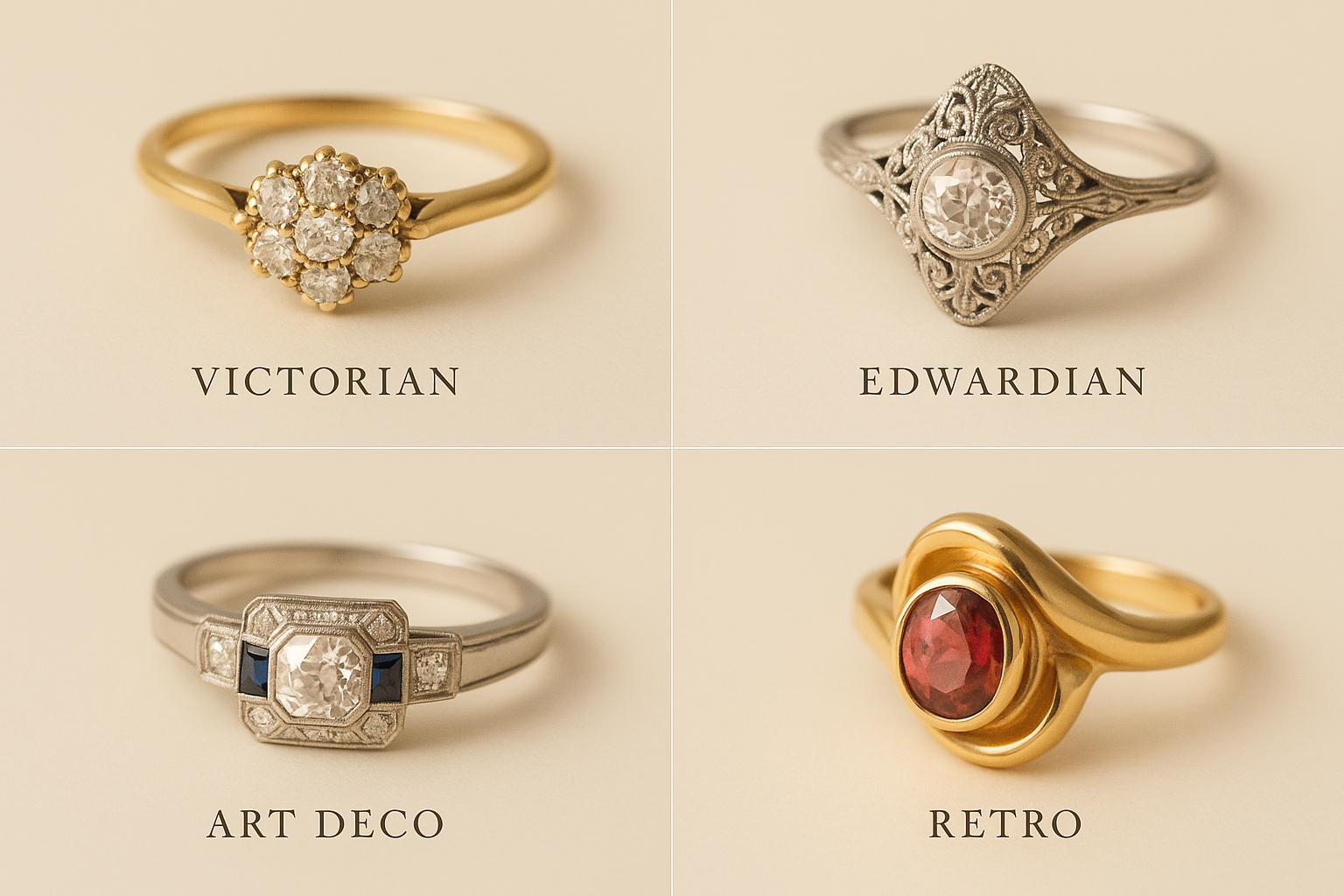
Four design eras at a glance: Victorian warmth, Edwardian lacework, Art Deco geometry, Retro gold volume
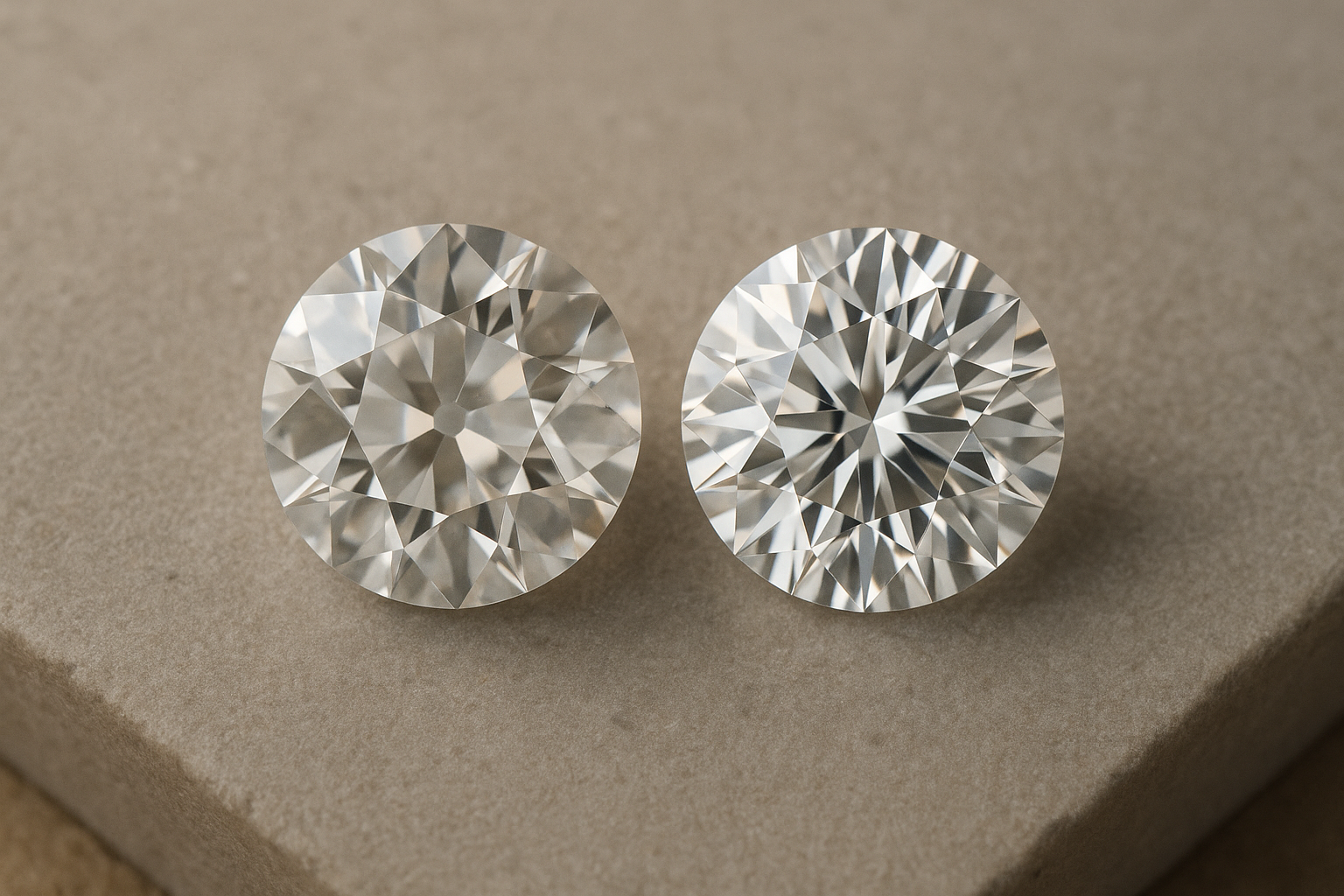
Old european cuts show chunkier facets and a small open culet compared with the modern round brilliant
What Are Old Mine Cut and Old European Cut Diamonds?
Old mine cuts and old European cuts are antique diamond cutting styles, hand-faceted before modern machinery, with higher crowns, smaller tables, and open culets than today’s round brilliant. The old mine cut, common through the 1800s, has a squarish cushion-like outline because cutters followed the rough crystal’s natural shape. The old European cut came later with a round outline and is the direct ancestor of the modern round brilliant. Both were cut to perform under candlelight, so they throw broad, slow, chunky flashes of light rather than the tight white sparkle of a modern stone. [NEEDS PROOF: GIA published material on antique cutting style proportions and facet structure before stating specific proportion figures.]
| Feature | Old Mine Cut | Old European Cut | Modern Round Brilliant |
|---|---|---|---|
| Outline | Cushion-ish, squarish | Round | Round |
| Table | Small | Small | Large |
| Crown | High | High | Lower |
| Culet | Open, often visible | Visible | Pointed or none |
| Light effect | Broad, warm flashes | Chunky fire | Maximum white brightness |
GIA and IGI both grade old cut stones, and reports typically classify them under descriptive cut terminology rather than the modern cut grade scale [NEEDS PROOF: sample GIA and IGI report language for old cut classifications]. Expect antique stones to carry lower color and clarity grades by modern standards; a warm J-K color often suits the antique look. Newly cut old-style diamonds, including certified lab-grown options covered in our lab-grown vs natural diamond guide, deliver the antique facet pattern with modern precision, and they set cleanly into contemporary round engagement ring designs.
Antique vs Vintage-Inspired: Which Should You Buy?
Buy a true antique if you value original history and accept condition risk; buy a vintage-inspired new build if the ring will be worn daily and you want a certified stone, exact sizing, and full-thickness metal. Cost does not settle the question on its own. Antique pricing is driven by rarity, era, and condition rather than carat weight alone, so a comparable-quality antique can cost more or less than a new custom build [NEEDS PROOF: collect internal pricing examples from The Local Jewel sourcing before publishing figures]. Durability is the clearer dividing line. A century-old ring often carries worn prongs, a thinned shank, and delicate filigree that raise repair risk under everyday wear. A new build reproduces the same milgrain and filigree details at original metal thickness, with prongs engineered for daily use.
Certification and fit also separate the two paths. Antique stones frequently come unpapered, and grading typically requires the diamond to be removed from its mounting [NEEDS PROOF: confirm current IGI and GIA policies on grading mounted stones]. A custom vintage-inspired ring ships with a current IGI or GIA report and is made to your exact finger size, while heavily engraved or filigree antique shanks limit how far a jeweler can safely resize them. On uniqueness, both win: a true antique is one of one with a past, and a well-designed custom ring is one of one by intent. See how to choose an engagement ring setting for structural decisions, or start a custom design consultation at The Local Jewel.
| Criteria | True Antique | Vintage-Inspired New Build |
|---|---|---|
| Cost | Varies by rarity and condition, not just carat weight | Predictable; priced on specs and stone |
| Daily-wear durability | Worn prongs and thin shanks add repair risk | Full-thickness metal, modern prong engineering |
| Certification | Often unpapered; grading may require unmounting | Current IGI or GIA report included |
| Resizing | Limited range on engraved or filigree shanks | Made to size |
| Warranty | Rare; sold as-is by most estate sellers | Standard on new work |
| Uniqueness | One of one with genuine history | One of one by design |
| Best for | Collectors, occasional wear, condition-risk tolerance | Daily wear, certified stone, exact specs |
Are Antique Engagement Rings Durable Enough for Everyday Wear?
Many antique engagement rings can handle daily wear, but only after a jeweler inspection confirms the metal and settings have life left in them. A century of use creates predictable failure points: prong tips worn thin or flat, shanks thinned from decades of contact with adjacent fingers and hard surfaces, cracked or bent filigree, and loose bead-set accent stones whose tiny metal beads have eroded. Solder seams from past sizings and repairs are additional weak points, since old repairs were not always done to modern standards. Before buying, have a jeweler examine prong integrity under magnification, measure shank thickness at the thinnest point, test every stone for movement, and identify prior repair work. [NEEDS PROOF: published trade or metallurgical data on comparative wear behavior of older gold alloys vs platinum before stating metal-specific claims.]
Expect more maintenance than a new ring: a daily-wear antique should be checked every six months, versus roughly annual checks for modern construction, and some repairs carry real risk to original details. Retipping worn prongs is routine and preserves the ring; rebuilding a collapsed gallery or replacing a paper-thin shank crosses into reconstruction, where original hand engraving and filigree can be lost to heat and new metal. If the honest repair estimate approaches rebuilding the ring, a vintage-inspired new build usually makes more sense. Pair either choice with a low-profile band that will not grind against fragile settings - see our wedding bands - and bring the ring in for a pre-purchase inspection before you commit.
Can You Make a New Engagement Ring Look Vintage?
Yes - a custom jeweler can reproduce nearly every antique design detail in a newly made ring, giving you the era aesthetic with modern structural integrity and a certified stone. The details that make a ring read as antique are all buildable today:
- Milgrain edging (the beaded border on Edwardian and Art Deco bands)
- Filigree and pierced galleries under the center stone
- Hand engraving on shoulders and shanks
- Bezel and half-bezel settings typical of earlier eras
- Cathedral shoulders and calibre-style accent stones
- Geometric Art Deco halos and step-cut side stones
Cut choice does the rest of the work. Old-style cuts, antique cushions, and elongated shapes like marquise, pear, and oval diamonds all read as era-appropriate when set in period-correct mountings. Honest labeling matters: a new ring with era details is vintage-inspired, not vintage, and should always be sold as such.
The practical advantage of building new is pairing era styling with an IGI or GIA certified lab-grown or natural diamond, which removes the condition, chipping, and grading uncertainty that comes with century-old stones and settings. The Local Jewel builds vintage-inspired rings through a custom process that starts with your era reference photos, moves through design review [NEEDS PROOF: confirm current consultation and CAD process steps with the team], and finishes with a ring engineered for daily wear - full prong coverage, solid shank weight, and modern setting security behind the antique face. Winter Park and Orlando buyers can book an in-person consultation to compare old-cut and modern-cut stones side by side before committing to a design.
How Do You Buy a Vintage or Antique Style Ring With Confidence?
Buy with confidence by verifying three things before payment: the era claim, the documentation, and the seller’s return policy. On any listing, treat these as red flags: “vintage style” priced like a true antique, no close-up photos of hallmarks or metal stamps, vague era language (“Deco-era feel”) with no date range, and no return window. A genuine estate seller can tell you how the piece was dated, what has been repaired or replaced, and whether the center stone is original to the mounting. Ask for a grading report if one exists, a written appraisal, condition notes, and repair history. If a lab report is provided, verify the report number directly with the issuing lab [NEEDS PROOF: current URLs and features of GIA Report Check and IGI verification].
For a new vintage-inspired build, the standard is simpler: a current IGI or GIA report matching the exact stone, a metal purity stamp in the finished ring, and written specs before you approve production. Use this checklist for either path:
- Era claim backed by specific dates, not adjectives
- Hallmark and stamp photos on request
- Grading report or appraisal, verified with the lab
- Condition and repair history in writing
- Return policy stated before purchase
- Prong and shank wear inspected by a jeweler
- Resizing feasibility confirmed before you commit
- Total cost compared against a custom quote
Winter Park and Orlando buyers can bring an estate find to a single consultation and compare it against a custom quote side by side. Book a design consultation to price a vintage-inspired build with a certified stone, browse engagement ring styles, or start with how to choose a lab-grown diamond.
What Are the Major Antique Ring Eras: Victorian, Edwardian, Art Deco, and Retro?
The four design eras most buyers encounter are Victorian (circa 1837-1901), Edwardian (circa 1901-1915), Art Deco (circa 1920-1935), and Retro (circa 1935-1950), each with distinct metals, motifs, and diamond cuts. Knowing the era name lets you ask a jeweler for the exact look instead of the vague label “vintage.”
| Era | Circa Dates | Dominant Metals | Signature Design Details | Typical Center Cuts | Best For | Not Ideal For |
|---|---|---|---|---|---|---|
| Victorian | 1837-1901 | Yellow gold, rose gold | Romantic motifs, snake and floral designs, cluster settings, dark accent stones like garnet | Rose cut, old mine cut | Buyers who want warm gold tones and soft, hand-cut sparkle | Buyers wanting bright white metal or maximum brilliance |
| Edwardian | 1901-1915 | Platinum, platinum over gold | Filigree lacework, milgrain edging, garland and bow motifs, knife-edge bands | Old European cut, rose cut | Buyers drawn to delicate, airy detail and white metal | Everyday heavy wear; fine filigree is fragile and hard to repair |
| Art Deco | 1920-1935 | Platinum, white gold | Strong geometry, symmetry, calibre-cut sapphire or onyx accents, stepped shoulders | Old European cut, transitional cut, early emerald cuts | Buyers who want bold structure and high contrast; the most requested antique look | Buyers wanting organic, curved, romantic styling |
| Retro | 1935-1950 | Yellow and rose gold, often lower platinum use tied to wartime restrictions [NEEDS PROOF: source on US War Production Board platinum use restrictions] | Bold sculptural volume, scrolls, large cocktail-scale settings, colored center stones | Transitional cut, early round brilliant, large synthetic and natural colored gems | Buyers who want a bold, glamorous statement in gold | Buyers seeking a dainty or minimal profile |
Retro is a specific mid-century design period, not a synonym for vintage. A ring made in 1945 with sculptural gold scrollwork is Retro by design and antique by age only once it crosses the 100-year line. Note that all date ranges above are circa conventions; era boundaries overlap because styles transitioned gradually, and a single ring can carry details from two adjacent eras. Every one of these looks - filigree, milgrain, geometric shoulders, old-cut faceting - can be reproduced in a new custom build with a certified IGI or GIA stone if a true period piece is too fragile or too scarce for your budget.
Frequently asked questions
What is the difference between vintage and antique engagement rings?
An antique engagement ring is at least 100 years old, while a vintage ring is generally 20 to 50 years old. Antique covers eras like Victorian, Edwardian, and early Art Deco. Vintage covers later 20th-century pieces. Jewelers also use vintage-inspired for brand-new rings built with era details like milgrain, filigree, and old-style diamond cuts.
How old does a ring have to be to be considered antique?
A ring must be at least 100 years old to be considered antique by standard trade convention. Rings younger than that but older than roughly 20 years are called vintage. Because the 100-year line moves every year, early Art Deco rings from the 1920s now qualify as antique, while mid-century pieces remain vintage.
What does vintage-inspired engagement ring mean?
A vintage-inspired engagement ring is a newly made ring that reproduces the design language of an older era, such as milgrain edges, filigree, halo frames, or old-cut style diamonds. It is not old itself. The advantage is antique aesthetics with modern durability, unworn prongs, current sizing, and a certified IGI or GIA graded center stone.
What is a retro engagement ring?
A retro engagement ring comes from the Retro design period, roughly the late 1930s through the 1950s. The style favors bold, sculptural gold, larger scale settings, and mixed metals influenced by wartime platinum restrictions. Retro rings are old enough to be vintage but not yet antique, since they fall short of the 100-year threshold.
Are antique engagement rings durable enough for everyday wear?
Many antique engagement rings are not ideal for daily wear without restoration. A century of use thins prongs, wears shanks, and weakens delicate filigree, so stones can loosen. A jeweler should inspect prongs, gallery work, and shank thickness before purchase. Buyers who want the look for everyday wear often choose a vintage-inspired build with new, full-thickness metal instead.
Is it cheaper to buy an antique ring or a vintage-inspired ring?
It depends on the piece. Antique rings can cost less than new rings of similar carat weight because old cuts and worn settings trade below modern equivalents, but rare signed or period-perfect pieces command premiums. Vintage-inspired custom rings carry predictable pricing, include a certified stone, and avoid restoration costs like re-tipping prongs or rebuilding worn shanks.
What are old mine cut and old European cut diamonds?
Old mine cuts and old European cuts are hand-cut antique diamond styles that predate the modern round brilliant. Old mine cuts have a cushioned square outline, small table, high crown, and large culet, common through the Victorian era. Old European cuts are rounder with a small table and open culet, typical of Edwardian and Art Deco rings. Both show broader, softer light patterns than modern cuts.
Can you make a new engagement ring look vintage?
Yes. A custom jeweler can build a new ring with authentic era details, including milgrain beading, hand-pierced filigree, engraving, bezel or halo settings, and antique-style diamond cuts. The result reads as antique but starts with fresh metal, secure new prongs, and a certified IGI or GIA graded diamond, making it suited to everyday wear.
Should I buy an antique engagement ring or a vintage-inspired reproduction?
Buy antique if you value authentic history, one-of-a-kind character, and accept restoration and resizing risk. Buy vintage-inspired if you want the era aesthetic with modern structural integrity, a certified diamond, exact sizing, and warranty-friendly new construction. Antique diamonds often lack lab reports, while a custom build starts with documented IGI or GIA grading.
Ready to design your piece?
Get 3D renders + a written quote within 24-48 hours - no payment required until you love the design.
Start your custom quote