Best Place to Buy Lab Grown Diamond Engagement Ring Online

The best place to buy a lab grown diamond engagement ring online is a jeweler that sells only IGI or GIA certified stones, lets you verify every report number on the lab’s own website, itemizes pricing for the diamond and setting separately, manufactures the ring rather than reselling it, and states return and warranty terms in writing before purchase.
TL;DR
- Buy only from sellers offering IGI or GIA certified lab-grown diamonds, and verify the report number yourself on igi.org or gia.edu before paying - if a seller cannot provide a report number to check, walk away.
- Require itemized pricing that separates the diamond cost from the setting cost; bundled “ring prices” hide markup and make it impossible to compare stones across sellers.
- Prefer a jeweler that manufactures the ring in-house over a reseller drop-shipping from a third party - manufacturers control quality, can customize the design, and can actually service the ring later.
- Get return and warranty terms in writing before purchase: the return window in days, whether custom work is excluded, who pays return shipping, and what the warranty covers (prong retightening, rhodium replating, resizing).
- Compare at least three sellers on identical specs - same carat weight, cut grade, color, and clarity from the same lab - so price differences reflect the seller, not the stone.
- Test responsiveness before you buy: ask a specific technical question (for example, the stone’s table percentage or fluorescence) and judge whether a knowledgeable human answers, because that same channel is your only recourse if something goes wrong.
What Is the Best Place to Buy a Lab Grown Diamond Engagement Ring Online?
The best place to buy a lab grown diamond engagement ring online is any seller that passes five verifiable trust criteria, not a single name from a ranked list. Ranked “best of” articles age badly: inventory, pricing, and policies change monthly, and a listicle cannot tell you whether the specific stone and seller in front of you check out. A criteria checklist can. Before paying any retailer, confirm all five:
- Certification on every stone - an IGI or GIA report you can verify by number on the lab’s own website
- Transparent pricing - the stone, setting, and any fees itemized separately
- Maker status - the seller manufactures or hand-builds the ring, not just drop-ships it
- Written return and warranty terms - published, specific, and dated before checkout
- True customization - the ability to modify or design the setting, not just swap stones into stock mounts
The Local Jewel meets these criteria as a Winter Park / Orlando custom jeweler: every stone carries IGI or GIA certification, pricing is quoted at private-jeweler rates with the stone and setting itemized, and each engagement ring is built to order rather than pulled from a warehouse. The rest of this guide breaks down each criterion so you can apply the same test to any seller, including this one.

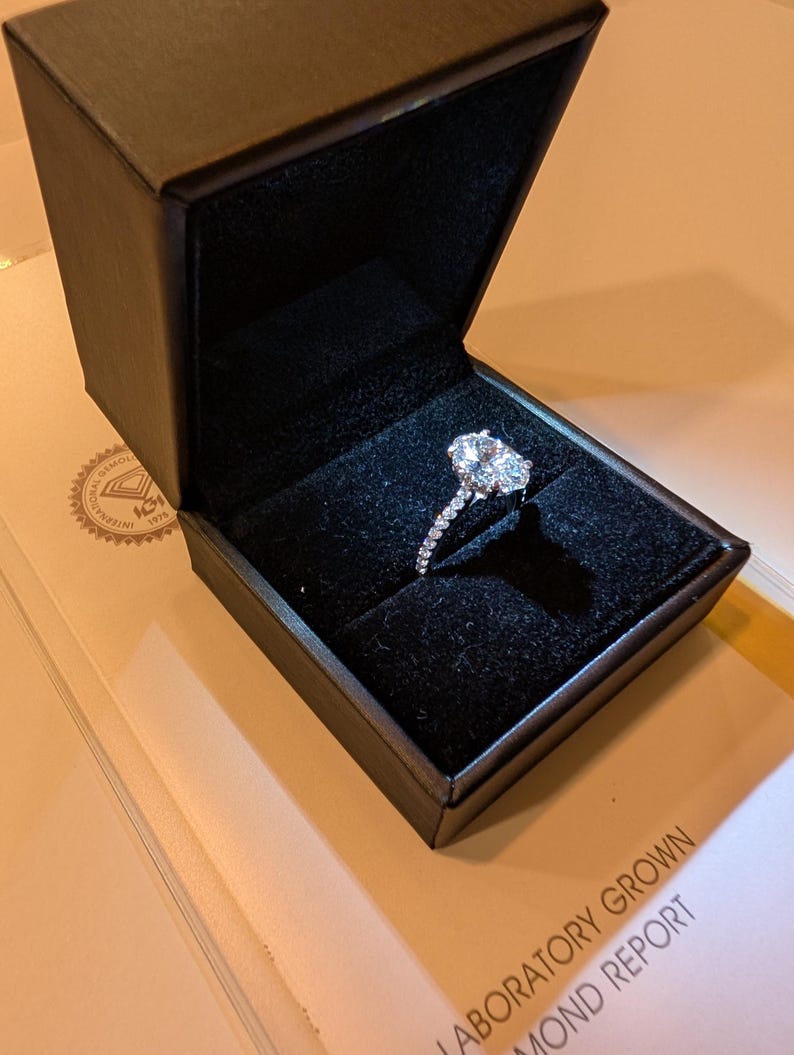
Five verifiable criteria that separate a trustworthy lab grown diamond seller from a risky one.
Is It Safe to Buy a Lab Grown Diamond Ring Online?
Yes, buying a lab grown diamond ring online is safe when the stone carries an IGI or GIA grading report and the seller publishes the report number before you pay. Both labs offer free online verification tools: enter the report number on igi.org or GIA’s Report Check and confirm the carat weight, color, clarity, and cut grades match the listing exactly. Most lab-grown diamonds also carry a laser inscription of the report number on the girdle, visible under 10x magnification, giving you a physical check when the ring arrives. This turns safety into a verifiable fact rather than a trust exercise. If a listing shows the grades but hides the report number until after purchase, ask for it first; a legitimate seller will provide it without hesitation.
Walk away from any seller showing these red flags:
- No report number displayed or provided on request
- In-house “certificates” instead of independent IGI or GIA reports
- Generic stock photos rather than stone-specific images or video
- No physical business address or phone number
- Uninsured shipping on a four or five figure package
A reputable jeweler ships fully insured with signature required on delivery and provides an appraisal for insurance afterward. If you want a second opinion on a listing or report before committing anywhere, send it to us and we will review it with you.

Verification workflow: find the report number on the listing, check it on the grading lab’s website, and confirm the girdle inscription on delivery.

The laser inscription on the girdle should match the grading report number, a physical check any buyer can request.
IGI vs GIA: Which Certification Should a Lab Grown Diamond Have?
Either an IGI or GIA report is acceptable for a lab grown diamond engagement ring, and anything else is not. Both are independent laboratories that grade lab-grown stones on the same 4Cs framework used for natural diamonds: D-Z color, FL-I3 clarity, and cut grading for round brilliants. IGI is the report you will see most often on lab-grown listings [NEEDS PROOF: citable IGI lab-grown grading volume source, or soften to trade observation], while GIA’s full 4Cs grading of lab-grown diamonds is a more recent program. A report from an in-house lab, an unknown lab, or the retailer itself is not a substitute. Grading only means something when the grader has no stake in the sale.
Here is what each report gives you in practice:
| Report field | IGI Lab Grown Report | GIA Laboratory-Grown Report |
|---|---|---|
| 4Cs grades (color, clarity, cut) | Yes | Yes |
| Growth method disclosed (HPHT or CVD) | Yes | Yes |
| Measurements and proportions | Yes | Yes |
| Laser inscription matching report number | Yes | Yes |
| Online report verification | Yes, at igi.org | Yes, via GIA Report Check |
Shop by the report grades plus the actual stone video, not by lab brand alone. A well-cut IGI-graded stone can outperform a mediocre GIA-graded one, so paying a premium purely for the lab name without comparing the diamonds is wasted money. Whichever report your stone carries, verify the report number on the lab’s own website before paying, and confirm the inscription matches on delivery. For how these grades translate between lab-grown and natural stones, see our lab grown vs natural diamond comparison.

Either an IGI or GIA report is acceptable; the grades and the stone-specific video matter more than the lab’s name.
How Do You Know If a Lab Grown Diamond Website Is Legit?
A legitimate lab grown diamond website shows stone-specific certification tied to a report number, itemizes the stone and setting as separate line items, lists real contact channels, and publishes written return, sizing, and repair policies. Any retailer missing one of these four signals deserves extra scrutiny before you send a four or five figure payment. The fastest single test: take the report number from any listed diamond and verify it directly on the issuing lab’s website. A seller whose listings do not include verifiable report numbers is asking you to buy on trust alone, which no serious jeweler requires.
The second test is maker status. Ask who sets the stone, who sizes the ring, and who handles repairs after the sale. A working jeweler or manufacturer controls quality at every step; a drop-ship reseller adds a markup layer and outsources the work to parties you cannot vet. Resellers rarely answer these questions plainly. The Local Jewel operates as a working jeweler serving Winter Park and Orlando, and answers all three questions in a free consultation before any payment. [NEEDS PROOF: confirm exact production/setting workflow with TLJ before publish]
Run this ten-minute audit on any retailer, including The Local Jewel:
- Certification: Every diamond listing shows an IGI or GIA report number you can verify on the lab’s own site
- Itemized pricing: The final quote prices the stone and setting separately, with no vague “starting at” figures
- Maker status: The seller states in writing who sets, sizes, and repairs the ring
- Real contact: A physical studio or location, a named jeweler or team, and a direct phone or consultation option
- Written policies: Return window, resizing terms, and what happens if the stone arrives different from the listing video are all documented before checkout
How Much Should a Lab Grown Diamond Engagement Ring Cost Online?
The price of a lab-grown diamond engagement ring is driven by five factors: carat weight, cut quality, color, clarity, and the setting, with matched-spec lab-grown stones costing substantially less than natural diamonds [NEEDS PROOF: current percentage delta from TLJ matched-pair inventory data with as-of date]. Lab-grown prices have declined as production has scaled [NEEDS PROOF: dated pricing trend source or TLJ inventory data], and that has two practical consequences. First, do not buy a lab-grown diamond as a financial asset; buy it as a finished piece of jewelry. Second, the falling stone cost shifts where your money matters most: cut quality, which controls brilliance, and setting craftsmanship, which controls how the ring wears over decades. A full breakdown of the trade-offs is in our lab-grown vs natural comparison.
To compare quotes fairly, match every spec before comparing dollars: same carat weight, cut grade, color, clarity, and the same certification lab (IGI or GIA). A quote that looks cheaper often hides a spec downgrade. Watch for these too-cheap red flags:
- No certification, or a report from a lab other than IGI or GIA
- “Clarity enhanced” or “treated” in the fine print, which lowers value
- Bait pricing on stones that are “no longer available” when you inquire
Private-jeweler pricing typically sits below chain retail because there is no mall overhead, and competitive with online discounters on matched specs while including design consultation and in-house craftsmanship. Current settings and starting prices are in our engagement ring collection.
Online Retailer vs Local Custom Jeweler: Which Is Better for an Engagement Ring?
A mass online retailer is better for buyers who want a standard setting from a huge catalog; a custom jeweler is better for buyers who want a made-for-them design, a single accountable maker, and lifetime local service. Neither is universally superior. Large online retailers list tens of thousands of loose stones and stock settings, ship fast, and work well for confident buyers who can read an IGI or GIA report and a 360 video without help. Their weaknesses appear after checkout: the company that sold the ring rarely made it, sizing and repairs route through mail-in service queues, and stock settings allow limited modification. A custom jeweler flips those trade-offs: fewer stones on a public shelf, but full design control, in-person stone comparison, and one person responsible for the finished ring.
| Factor | Mass online retailer | Custom jeweler |
|---|---|---|
| Best for | Standard settings, fast timelines, self-directed buyers | Specific designs, hands-on comparison, ongoing service |
| Not for | Unique or modified designs, in-person guidance | Buyers who need a stock ring shipped this week |
| Accountability | Retailer sells; a third party often manufactures | One maker owns design, build, and quality |
| After the sale | Mail-in sizing and repair | Local sizing, prong checks, and repair |
A modern custom jeweler removes most of the remaining trade-off by combining online tools with a physical studio. The Local Jewel pairs an online design process and IGI/GIA certified stone sourcing with in-person consultations at its Winter Park studio serving the Orlando area [NEEDS PROOF: confirm current consultation format and service/warranty terms with TLJ]. The service-life reality favors this model: engagement rings are worn daily and need periodic sizing, prong inspection, and eventual repair, and who performs that work matters for decades. Buyers comparing setting styles before deciding can start with how to choose an engagement ring setting, or book a consultation to compare certified stones in person.
What Return Policy and Warranty Should You Expect When Buying a Ring Online?
Before paying, get four terms in writing: the return window and its conditions, the custom-work exclusions, the resizing policy, and the workmanship warranty. If a seller will not publish these terms or provide them on request, do not buy. Return windows on ready-made rings vary widely between retailers, so confirm whether the window starts at order or delivery, whether the ring must be unworn and untagged, and who pays return shipping and insurance. Fully custom rings are commonly non-returnable because the piece is made to your specifications, which means your real protection is the design approval process: insist on CAD renders, and ideally a wax or resin preview, with written sign-off at each stage before metal is cast. A seller that skips approvals on custom work is asking you to accept all the risk.
Warranty and resizing terms deserve the same scrutiny. A workmanship warranty should cover manufacturing defects, stone security in the original setting, prong tightening, and rhodium replating on white gold; it should not be confused with wear-and-tear coverage, and no seller warranty replaces insurance. Resizing also depends on the design: plain wedding bands and solitaires resize easily, while full eternity bands generally cannot be resized because stones circle the entire shank, so size accuracy matters most on those styles. The Local Jewel’s current written return, resizing, and warranty terms: [NEEDS PROOF: collect current written policy from TLJ before publish].
Get these six terms in writing before buying any ring online:
- Return window length, start date, and condition requirements
- Whether custom or engraved work is excluded from returns
- Resizing policy: free window, fee schedule, and non-resizable styles
- Workmanship warranty scope: prongs, stone security, replating, defects
- What voids the warranty, including outside repair work
- An appraisal document for the finished ring so you can insure it separately
How Does Buying a Custom Lab Grown Diamond Ring Online Actually Work?
A custom lab grown diamond ring built online follows five steps: a design consultation, certified stone selection, CAD design approval, production and setting, and insured delivery with final inspection. Each step includes a buyer checkpoint, so nothing is locked in until the design is approved. At The Local Jewel, the process starts with a free consultation where a jeweler narrows the setting style, diamond shape, and budget, then presents matched stone options at multiple price points. Every candidate stone comes with its IGI or GIA report number and a 360-degree video, so buyers compare actual stones, not stock photos.
| Step | What happens | What the buyer approves |
|---|---|---|
| 1. Consultation | Define style, shape, budget | Overall direction |
| 2. Stone selection | Certified options with video and report | The specific diamond |
| 3. CAD design | 3D renders of the setting | Final design, with revisions |
| 4. Production | Casting, setting, finishing | Nothing new; work matches the approved CAD |
| 5. Delivery | Insured shipping, final inspection | The finished ring |
The CAD stage is the safety net: buyers see photorealistic renders and can request changes before any metal is cast. Typical custom production runs [NEEDS PROOF: confirm TLJ’s current production timeline range] from design approval to delivery, so buyers planning a proposal should build in lead time. To start, book a free custom consultation, or browse shapes first in the oval, round, or pear collections to bring a starting point to the design conversation.
Lab-Grown vs Natural Diamonds: Side-by-Side Comparison
Lab-grown and natural diamonds are chemically, physically, and optically identical; the only differences are origin, price, and long-term value behavior. The table below shows where each option wins so you can match the stone to your budget and priorities.
| Factor | Lab-Grown Diamond | Natural Diamond |
|---|---|---|
| Composition | Crystallized carbon, identical to natural | Crystallized carbon |
| Hardness (Mohs scale) | 10 | 10 |
| Origin | Grown in weeks via HPHT or CVD process | Formed in the earth’s mantle over roughly 1 to 3 billion years, per GIA |
| Grading | Graded on the same 4Cs scale, most commonly by IGI; GIA also grades lab-grown | Graded on the 4Cs scale by GIA, IGI, and others |
| Certificate disclosure | Report states “laboratory-grown”; girdle is laser-inscribed | Report states natural origin |
| Price per carat | Typically a fraction of natural at the same size and quality [NEEDS PROOF: current per-carat comparison from our own inventory, e.g. 1.5 ct F VS1 lab vs natural] | Priced by rarity; cost rises steeply with carat weight |
| Resale and trade-in value | Low resale market; prices have declined as supply grows [NEEDS PROOF: our trade-in policy terms for lab-grown] | Established secondary market; better value retention, though most diamonds resell below retail |
| Rarity | Not rare; production scales with demand | Finite supply, especially in high color and clarity at larger sizes |
| Detection | Distinguishable from natural only with specialized lab instruments, not by eye or standard loupe | N/A |
| Best for | Maximizing size and quality on a fixed budget; buyers who prioritize the finished ring over resale value | Buyers who value rarity, tradition, or potential heirloom and trade-in value |
| Not for | Buyers who expect the stone to hold monetary value | Buyers stretching a tight budget who want a specific carat size |
Both options come with full grading reports, and either can be set in any custom design. The practical decision usually comes down to one question: would you rather have a larger, higher-grade stone now, or a rarer stone with a functioning resale market later?
Frequently asked questions
Where is the best place to buy a lab grown diamond engagement ring online?
The best place is any seller that meets five criteria: independent certification (IGI or GIA) on every stone, itemized pricing for diamond and setting, in-house manufacturing rather than drop-shipping, real customization capability, and a written return and resize policy. Judge sellers against these standards instead of marketing claims. Independent jewelers like The Local Jewel and large e-commerce brands can both qualify; the criteria matter more than the name.
How do I know if an online lab grown diamond retailer is legit?
Verify three things before paying: a lab report from IGI or GIA that you can confirm on the lab's own website using the report number, a physical business address with a reachable human, and a written return policy of at least 14 days. Legitimate sellers also disclose whether they make rings in-house or resell from third-party vendors. Any seller that resists these questions is a red flag.
Is IGI or GIA certification better for lab grown diamonds?
Both are credible for lab-grown diamonds. IGI grades the majority of lab-grown stones on the market and its reports are the industry standard for this category. GIA also grades lab-grown diamonds using its full color and clarity scales. What matters most is that the report exists, matches the stone's laser inscription, and can be verified on the lab's official database.
What should I look for when buying a lab grown diamond online?
Prioritize cut quality first, then the certificate, then price. Cut controls brilliance more than color or clarity, so favor Excellent or Ideal cut grades. Confirm the stone has an IGI or GIA report with a matching girdle inscription. Review actual video of the specific stone, not a stock render. Finally, compare price per carat across sellers for identical specs to spot overpricing.
What is a normal return policy when buying a lab grown diamond ring online?
A 14 to 30 day return window is standard for online diamond ring purchases, with 30 days common among major e-commerce sellers. Fully custom designs are often final sale or partially refundable, which is normal because the ring was built to your specs. Before ordering, get the return terms, resize policy, and any restocking fees in writing. No stated return policy means do not buy.
Should I buy an engagement ring from an online retailer or a local jeweler?
A local custom jeweler is better if you want to see stones in person, modify the design, and have one accountable person handle sizing and repairs. A large online retailer is better if you want maximum inventory browsing and standardized pricing. Independent jewelers with online sourcing, like The Local Jewel in Winter Park, combine both: certified stones at private-jeweler pricing plus in-person service.
What questions should I ask before buying a lab grown diamond engagement ring?
Ask these five: Is the diamond certified by IGI or GIA, and can I verify the report number? Do you manufacture the ring or drop-ship it? What is the itemized price of the stone versus the setting? What are the return, resize, and warranty terms in writing? Can I see video of my exact stone? A trustworthy seller answers all five directly.
Can I get a custom lab grown diamond engagement ring made online?
Yes. Custom online ordering typically works in four steps: consultation on budget and style, diamond sourcing with certified options to compare, CAD renderings for approval before casting, then production and delivery. Expect several weeks from approval to finished ring depending on the maker. Confirm who does the actual manufacturing, because some sites outsource production, which limits quality control and future service.
How do I avoid overpaying for a lab grown diamond online?
Compare price per carat across at least three sellers for stones with identical cut, color, and clarity grades on IGI or GIA reports. Lab-grown pricing varies widely between retailers for equivalent stones because markups differ, not quality. Slightly off-round specs, such as a 1.9 carat instead of 2.0, often cost meaningfully less with no visible size difference. Itemized quotes expose padded setting prices.
Ready to design your piece?
Get 3D renders + a written quote within 24-48 hours - no payment required until you love the design.
Start your custom quote